Showing posts with label Native American. Show all posts

Friday, November 18, 2011

Honoring the Dead

I'm back!  The past three months have been a whirlwind - moving (back) to Williamsburg, starting graduate school, and wedding planning - and somewhere along the way blogging got left in the dust.  Yet my mind has been brimming with thoughts and ideas, so here we go --

Recently, I've spent a lot of time thinking about my academic specialty and career in general.  While I have always loved being in school, life as a graduate student has certainly made me question my desire to get a PhD and pursue an academic career.  I suppose it's easy to idealize working or being in school from the other side of the fence - I certainly did when I was working full time.  This semester has been full of frustrations - fear of failure (or fear of just adequacy), a struggle to fit into an academic environment as a grad student, and efforts to maintain balance between "work" and "home".  All the same, I've at least reached an understanding of some academic interests (those pidgenholed "research interests" on a CV...) and tentitve ideas for my thesis.

Archaeological discovery of a human burial
As some of my readers will remember, I spent much of my "year off" working in repatriation, the return of human remains and objects to claimant Native American Tribes.  When I returned to William and Mary for graduate school this fall, I decided to take a class in human skeletal biology.  The inordinate amount of excitement I had for this class - which consisted of learning to identify and analyze in basic ways the bones of the human body - started the turning of the gears... 

In contemporary archaeology, you generally don't want to find burials.  Human bones mean paperwork, politics, and controversy, especially if they turn out to be the remains of Native Americans.  But I've realized over the past few months that sometimes the best way to mitigate controversies is to understand them, to be well versed in mortuary practices and skeletal biology so that when issues arise - whether in museum repatriation, construction projects, or academic archaeology - you are prepared to reach a compromise between the prerogatives of different communities.

From Written in Bone
Let's face it: we (Americans) don't like to talk about death.  It's the unknown, the uncertain (and in the case of zombies, the seriously frightening).  In some cultures, talking about death is taboo.  Yet for others - the Hispanic celebration of the Day of the Dead, for example - family members revisit the graves of the dead as a way of remembering their lives.  As Americans, we see great importance in honoring those who have gone before us, especially those who died tragically or in military conflicts, as revealed in recent controversies about Arlington Cemetery, the Air Force (and this), and the placement of the remains of 9-11 victims in a public memorial museum.  But it's important to remember that culturally, we understand death, burial, and memory in very different ways - hence the reason why the remains of early Euro-American settlers can be displayed in a museum while it would be unacceptable (today) to display Native American remains in a similar way.

I see the study of the dead as an important way to honor those who have come before us, by remembering their lives.  Just think about it.

Remembering those who died on 9-11

Saturday, July 23, 2011

before-it-was-Virginia Heritage: Wade Site

I got up obscenely early (as in, before 5am) on a Monday morning in June, packed up my car, and drove down to Longwood University's campus in Farmville.  From there, I joined a caravan to the site house, then onto the Randy K. Wade Site in Randolph, Virginia.  Archaeologists and field school students from Longwood have been excavating at the Wade Site for over ten years, which has allowed them to amass a huge amount of data on the Native Americans who lived there from about AD 900-1425.  They also conduct their research in consultation with Sappony Indian Tribe of Virginia and North Carolina (which I find especially exciting).

Geographic location of the Wade Site, 44CH62, in Charlotte County, Virginia

This year, the field school opened an 8x8 meter unit (note: this is a pretty large area, but manageable with 20 eager diggers).  I volunteered during the third of four weeks, when they were cleaning up the lower portions of the plow zone (natural or cultural fill disturbed by plowing, usually a couple feet deep) and beginning to define the outline of features (cultural deposits like pits, postholes, and hearths).  They drew plan maps of their features on Friday morning and started excavating them in the afternoon.  I wish I could have stuck around for the rest of the field school to see how feature excavation went!

The block had dozens of features - we're looking at some pretty dense occupation here!

Since my experience in prehistoric archaeology has primarily been in the southwest, this week was a great opportunity to experience Mid Atlantic/Southeastern material culture.  Since the site was probably an island on the Staunton River during its prehistoric inhabitation, there was a lot of fish bone, turtle bone and shell, and riverine shell.  Additional artifacts included ceramics and lithics - both projectile points and debitage/flakes (the "byproducts" of stone tool production).  There were also some human remains uncovered - as I understand it, not an uncommon occurrence for this site.  Longwood archaeologists and Sappony leaders have consulted and worked out a procedure for the partial excavation of human remains and associated funerary objects - after which all materials are reburied.  I found this agreement particularly interesting (and promising), especially considering the sensitivity of such issues.

Discussing the context and treatment of human remains at the site

Despite the incredible heat, my week with Longwood's field school was a really great experience.  They were a very hospitable group and I really enjoyed spending time with everyone both on and off-site.  Guess this is what it's like being in the (real) South!

Monday, December 20, 2010

Twenty Years

Please forgive my long hiatus.  It has been a busy month, between state-hopping, holidays, job-searching and grad school applications.  I'm currently enjoying a relaxing stay with Paul's family in New Jersey.  My Christmas shopping is done (well, almost), my gifts are wrapped, and I'm getting a good rest before the baking-and-wrapping extravaganza that will be Wednesday and Thursday.  Come mid-January I will be starting a post-graduate certificate in Geographic Information Systems (yay!).  In the coming weeks and months I hope to have official news about jobs and graduate school.

In a previous post, I outlined the basics of repatriation and legislation under the Native American Graves Protection and Repatriation Act (NAGPRA) and the National Museum of the American Indian (NMAI) Act.  In honor of the 20th anniversary of NAGPRA, George Washington University held a symposium in mid-November.  Those two days were an illuminating experience, revealing the deep hurt difficult conflicts that are an inevitable part of the repatriation process.  Scientists, curators, and Native Americans spoke of their divergent experiences and perspectives.  It was a very moving experience - an chance to see human faces rather than the simply sherds and bones and dirt of archaeology.

The difficult: The sorrow of Native people whose continued efforts have been unsuccessful.  The hurt that has a place, even in successful repatriations.  The yet unresolved disagreements between scientists and Native people.  The inspiring: Beginning and ending each day with prayer.  Inspiring stories.  Academics and curators with the courage to admit wrong practices.  The opportunity to learn from the experience of so many others.

I continue to be glad that I decided to take time off before grad school.  I am learning so much from these unique opportunities, things I most certainly would have missed had I decided to push on through.  As I anticipate returning to the hotbed of academic theory and thought, I do not want to forget the human faces - the the human experience that unites us all, regardless of time period, culture, or language.

National Museum of the American Indian

Saturday, November 13, 2010

Days at the Museum

It's hard to believe - I'm already halfway through my internship at the Smithsonian.  It's been a fun five weeks so far, full of museums and behind-the-scenes collections tours...and, you know, work.

Posing with Kari and Carrie
A couple weeks ago, I was walking with a few of my coworkers over to the Museum Support Center (MSC), and we caught sight of the above vehicle.  I guess it was some kind of advertising ploy (I forget the website the was written on the back) - but this van was pimped out with all kinds of halloween/graveyard-style stuff.  I believe it was called the "Vanadu."

Enjoying preserved organics!
In a previous post, I regaled you with the story of our tour of the NMAI's collections.  That day we primarily went through the ethnographic collections, which contains items acquired from people (not excavated) over the past hundred years or so.  Since then, I've also had the opportunity to look around the archaeological collections, which includes artifacts that are thousands of years old.  We looked through collections from a dry cave in Arkansas, which mean preserved organic material - baskets, bags, bones, seeds, wood - all still intact after thousands of years in the ground.  It's pretty darn awesome.

With old exhibit props
Finally, I had the much-awaited tour of Natural History's Museum Support Center - also known as "where they keep the Ark".  I must say, they have some pretty cool stuff from all over the world.  Chinese opium pipes.  A million-year-old (and proto-human made) hand axe.  One of the Easter Island heads.  Mesoamerican sculpture.  Parkas made from seal gut.  Old exhibit props.  Both of the collections buildings in Suitland (NMAI and NMNH) were built during the 1990s, and are truly state-of-the-art facilities.  I'm glad that the Smithsonian is taking good care of the world's treasures.

I didn't find the Ark.  Maybe I should keep a look out for secretive-looking black cars pulling through the wrought iron gates...

Natural History's Museum Support Center

Monday, October 25, 2010

Indiana Jones and the Mystery of Storage Space

Do you remember the last scene from Raiders of the Lost Ark?  You know, post wrath-of-God and Nazi face-melting, pre-final kiss with the lovely Miss Ravenwood?  We see the ark, packed into a wooden crate, and loaded into a storeroom the size of a football field - which we must assume to be filled with similar such sacred treasures from faraway lands.  That place exists - in the Smithsonian museum support center in Maryland.

As a brief introduction to my current stage of post-graduation adventures (which have led me to such an Indiana Jones-esque discovery): I am interning at the National Museum of the American Indian (NMAI), a very recent addition to the Smithsonian.  I work at the Cultural Resource Center (CRC) in Maryland, sorting through papers and computer files relating to repatriation.  Repatriation is, in the most basic sense, the return of Native American (and Native Hawaiian and Alaskan) human remains, funerary objects, sacred objects, and objects of cultural patrimony, to tribes.  With the passage of the NMAI Act in 1989 and the Native American Graves Protection and Repatriation Act (NAGPRA) in 1990, museums, as well as federal and academic institutions are required to work with federally recognized tribes in order to return objects in the above categories.  I'll go into more detail in a future entry.

Today the interns (most of whom work at the museum in DC proper) visited the CRC for a tour of collections and various labs.  The CRC is a pretty recent building - it was opened in 1999 - and it is built to house collections in a respectful, considerate way.  To many native peoples, objects are alive, so it is important for them to be stored in an appropriate environment.  When I walked into the room, my jaw quite literally dropped at the kind of items before my eyes.  Totem poles, some more than fifty feet high.  Canoes.  Sculptures.  And as we explored the collections further; buffalo robes from the plains, feathered baskets from California, and kachinas from the southwest.  I felt alive among all these beautiful and powerful objects.  They are alive.

I hear that the Natural History Museum's collections (just a stone's throw away at the aforementioned museum support center) are extraordinary.  A very different environment from the NMAI CRC, with objects from all over the world.  We're scheduled to go on a tour in a few weeks - I'll let you know if I see the ark.

Tuesday, September 21, 2010

Chance Encounters

It's been a pretty quiet week - no big thunderstorms, field trips, or life-changing events.  I spent almost the entirety of last work week digging a small test unit (1x1 meter) - it just kept getting deeper and deeper, and I couldn't find any indication of sterile (sans artifacts) soil.  Alas, today my supervisor and I pulled out the big guns - a rock pick - and after some probing, he decided that it's probably an early kiva (circular subterranean structure).  So it looks like I have a lot of digging to go, but at least now I have some perspective.

I sit under this tree during lunch, and also occasionally nap.
This past Saturday was Crow Canyons second annual Open House Festival - visitors came from near and far to explore our reconstructed pithouse and pueblo, learn to throw an atlatl, and enjoy Chef Jim's delicious green chile stew!  It was a beautiful day and a lot of fun to see so many families enjoying campus.  It's days like these when I realize that while I enjoy archaeology, my passion is also to teach and make research accessible on lots of different levels.  As many of you also know, I am quite fond of talking, and it was fun to get to chat with so many different people during the Open House as well.

Friendship dance with the Pow Wow dancers at the Open House

On Sunday I made an expedition to a local coffee shop, in search of some good coffee and a change of scene.  The coffee was indeed delicious (I had the Guatemalan blend, of course), and I had some time to catch up on letters.  I also spent several hours in friendly conversation with a local storyteller (Remember Lorenzo?  This man was like his PG counterpart).  Cortez is such a welcoming place.  The community, if not the landscape, is probably my favorite thing about the area.

Mom and Dad are due to arrive in less than 48 hours - I can't express my excitement!  It will be so much fun to show them around Cortez and Crow Canyon, and I'm especially looking forward to our expedition into the mountains: Durango, Silverton, Ouray, Telluride, Rico, and Dolores.  The best part?  Each town has its own brewery!

Monday, September 13, 2010

On Home, and Hovenweep


All of the sudden, my life here has become almost, well, busy.  I'm down to the last three weeks of my internship, and perhaps for the best, I'll be working a lot, and running all kinds of crazy places before Paul flys out for the "extended" trip home.  I've snagged a sweet babysitting job, Crow Canyon's open house is set to happen this Saturday (somehow I've been assigned to the decorating committee...), and to boot, Mom and Dad are flying out for a visit mid-next week - we'll be driving up north into the mountains for a couple days.  I can't say that I'll miss the gloriously lazy evenings and weekends on campus too much.  I was never very good at being bored - or being motivated to get anything done unless there's a deadline.  As much as I despise beltway traffic and sprawling suburbs, it will be so good to be home.

Home.  It has come to mean so many different things to me over the past few years.  Home, where I grew up.  Home, where I walked colonial streets and figured out what kind of person I wanted to be.  Home, where I walked Spanish colonial streets and figured out what kind of person I wanted to be.  Where there are always people bugging me to bake pie; where leaves fall in the autumn;  where scorpions and rattlesnakes do not roam.  But most of all it's a place where I share my life with loved ones, and where I can be at peace with God.  It's human intimacy - in the best, most wholesome sense of the word - that I miss most when I'm away.  Hugs.  Heartwarming conversations.  Coffee.  Meals.  Smiles.

I remind myself each day that I am living such a wonderful experience out here.  I breathe deep as I walk up to my cabin in the chilly evening air, gazing at the big dipper and the milky way.  I soak in the sun during lazy lunches in the field.  I savor the delicious southwest-style food that the kitchen staff cooks up.  Life won't always be this simple, and this time is truly a gift.

My supervisor pulled one of these out of a kiva on Friday!

Last Saturday we took another intern field trip.  First we visited the Anasazi Heritage Center just a few miles north in Dolores, CO.  It was really cool to see some artifacts on display (mostly some unusual ceramic vessels), and grind maize with a mano and metate (it's really hard work!)  In the afternoon we drove west, across the border to southeast Utah.  A note on Utah: it's really desolate, at least the eastern portion that I have seen, aut at the same time the landscape is absolutely magnificent.  We visited the main site (Square Tower) of Hovenweep National Monument and hiked a few miles into and around the canyon.

Hovenweep's "Twin Towers," a fitting reminder for 9/11

It was a late site, late 13th century, with a whole ton of towers on the rims of canyons.  The function of towers in this period is still in many ways a mystery.  The fact that they built a big one inside the canyon leads me to believe that their function was not just defensive.  In any case, we headed back to Cortez in the early evening for a delicious dinner at the home of one of Crow Canyon's archaeologists, where I ate green chile stew, my new favorite food, for the first time.  I'm serious, this stuff is delicious.  It's like southwestern-style pot pie.  Only better.

The "Castle"
Excited for home, three weeks and counting.  But trying to make the most of every day I have left on the great sage plain.

Friday, September 10, 2010

Field Archaeology 101

It occurred to me a couple weeks ago that the practice of archaeology is a pretty abstract idea in most people's minds.  What do you think of when you imagine an archaeologist working in the field all day?  It's probably a lot different from what you would expect.  Yes, we dig holes, and yes, we collect artifacts - but we also take photographs, keep very exact measurements, make maps of our units, and spend a lot of time recording anything and everything about the soil.

The tools: tarp, buckets, dustpan, trowel and brush

One of the most important things to keep in mind about archaeology is that we record everything.  We want to know exactly where we are digging horizontally (this is where satellite technologies like GIS and GPS come in handy), and vertically, which means taking constant measurements of elevation.  Before you start to dig a unit, you have to plot its location on a map, and lay out its measurements with nails and string.  When you're trying to get a feel for how people used the landscape in the past, you have to be exact.  Most of what you'll learn from an artifact comes from its location (in archaeology jargon, its provenience).  That means digging a unit within the boundary of the strings, and also in vertical levels based on how the soil was deposited.

This unit has already been dug, but I need to document it

Units are usually measured in meters, except occasionally at historic sites.  The photo above is a 1x1 meter unit - this one was part of a midden, or an area where people deposited their refuse.  We find all kinds of things - pottery sherds, flakes from the construction of stone tools, charcoal, bone, and a whole lot of sandstone that was used for construction.

First thing's first - clean off all the crap!

Since the student and adult participants at Crow Canyon do most of the digging, my job is to take care of residual documentation, and get units ready to backfill (throw the dirt right back in).  I first clean the unit, and make sure we have reached sterile soil - that's what was there before people used the land.  It usually has a high concentration of clay, so it's the yellowish-red color you can see above.  This unit looks done - the brown stain in the lower half of the unit was probably caused by rodent activity.

The surface of a pit feature

Sometimes, however, once you get through a layer of soil, you can see the imprint of a feature, something caused by cultural activity that can't be removed from the ground and studied like an artifact.  The above photo represents a pit that was cut into the yellowish-red clay by people who lived here 800-900 years ago.  My job is to excavate the feature, taking lots of notes (and photos!) along the way.

I bisected the pit feature to look at a profile of the fill
All done!  A final photo for this midden unit.

Once everything in a unit is excavated, I take final photographs of the unit.  It is important to provide shade for photos with a tarp, so that the difference in color won't distort the picture (my earlier photos would not be appropriate for a site report - the ones above are much better).  There should always be an arrow or a trowel indicating north in the photo, to best record the orientation.

The tools: clipboard, graph paper, pencil, ruler, line level, tape measure

Finally, I finish up the unit by drawing a profile map to keep track of the change in soil color and texture.  We use a book called the Munsell soil color chart - just imagine a bunch of paint samples in dirt colors, bound together in a book - to try to be as objective as possible about the soil color.  It's more tedious work, but important for understanding how the soil layers were deposited, and thus learning about the relationship of one unit and its artifacts to another.

After that is another story - stay tuned to learn about artifact processing back in the lab!

Monday, September 6, 2010

A Tale of Two (or twenty) Kivas

Last weekend - back when it was still August - the interns took a weekend camping trip to New Mexico.  We're only about an hour from the border, and it took us about two hours to arrive at our first destination: Salmon ruins.  Salmon (pronounced Sal-mun after a local family, not the fish) is a site known as an "outlier" to the political/social/economic system of Chaco Canyon.  Think of the Roman Empire, and the way that Roman architecture spread throughout Europe in the early centuries AD.  Chaco was kind of like that - and associated sites are identifiable by similar architectural traits, burial patterns, kiva styles, and a lot of attention paid to astrological alignment, among other factors.  Salmon archaeologist Paul Reed gave us a behind-the-scenes tour of the site - meaning we got to learn about cool things like potential cremation remains and coprolites (yep, centuries-old poop) - and the destruction and reconstruction of Salmon's great kiva after a huge flood in the twelfth century.

Great House (Pueblo Bonito)
After our tour of Salmon, we drove another hour or two south to Chaco Culture National Historic Park.  Chaco has been on my list of places-to-visit since I first learned about it my freshman year of college.  As I have mentioned before, Chaco Canyon was (debatably) a huge political/social/economic system operating in the southwest between the ninth and twelfth centuries AD.  Chaco is known for its monumental architecture: three or four story "great houses" - village-size communities, and "great kivas," really big variations of the circular underground religious structures still used in modern Pueblo societies.  T-shaped doors, architecture with small, narrow stones and bands of dark stones, and "chinking stones" are also traits associated with Chaco.  (Are you still awake?)

Great Kiva (Chetro Ketl)

T-shaped door (Pueblo del Arroyo)

Banded masonry (Pueblo Alto complex)

We spent the weekend hiking and touring Chaco Canyon's bounty of great houses.  We also saw a lot of petroglyphs (pictures carved into rock), and some pictographs (pictures painted on rock) and did a lot of stargazing - there were some pretty cool shooting stars.  There is very little light pollution in Chaco, and we went to a presentation on astronomy given by a park ranger on Friday night, and even got to look through a gigantic telescope.

Petroglyph
Supernova pictograph

It was my first experience camping since the fateful night freshman year when I sprained my ankle.  Definitely a fun (injury-free!) weekend.  I'm pretty sure I ate my month's allowance of peanut butter in three days.  Peanut butter on both sides of the bread keeps the bread un-soggy from the jelly.  A peanut butter apple with granola is also a lovely breakfast.  Peanut butter is pretty much indestructible, and delicious.

Saturday, August 21, 2010

Destination: Mesa Verde National Park

Durango & Silverton Railroad (2004)
Right now I'm sitting outside a hole-in-the-wall bagel shop in Durango - about 50 miles east of Cortez.  This morning I drove one of the interns to the airport at oh dark thirty, so I figured I'd enjoy the change of scene out this way.  Durango is definitely a tourist town - complete with artsy shops, a historic railroad, and a lot of unique places to eat.  It's definitely a treat to get a bagel - you don't see them very often between St. Louis and well, California.

Mesa Verde at dusk
Today completes week four of my internship.  I just about have the weekly routine down (including unofficial field trip Fridays) and time is starting to pass a little more quickly.  This past week the interns got a taste of Crow Canyon's weekly program for students and adults who come to learn about archaeology.  We got to tag along with the adults in the lab, and the lab interns (also known as "labbies," we are "fieldies") got to come dig with us.  The week also included a field trip to Mesa Verde National Park (making it my second consecutive Friday in the park) about an hour southeast from Cortez.

Balcony House
Last Friday, I took a trip to Mesa Verde while most of the other interns were networking at the Pecos Archaeological Conference (I figured I'd save my networking for the east coast).  I drove around the park, getting a chance to see all kinds of pithouses and cliff dwellings.  I also took a tour of Balcony House - which meant climbing a 30-foot ladder to get to the site, and crawling through a narrow tunnel to get out.  It was a neat site - though I don't think Mom would have liked the heights very much :-P  In the evening I stuck around the park to hear George Mason Professor James Snead give a lecture on his research concerning ancient roads.

Mug House
Yesterday we toured Mug House - a pretty out-of-the-way cliff dwelling on Wetherill Mesa (to the west of Chapin Mesa, the main attraction).  We really had to do some adept rock-crawling to get down to the site, but it was worth it.  We got to see a painted kiva, and some pretty cool other structures.  The interns also drove to Spruce Tree House on Chapin Mesa.  It is splendidly preserved, and it was pretty awesome to give it a look with a more discerning eye than I had at 16 (when I visited Mesa Verde with Mom and Dad).

Otherwise, I've been doing a lot of chilling out, tasting the local beer (the writers of Dear Beer Friend would be proud), and working my way through the first season of Glee and The Columbian Exchange.  I wanted to thank everyone SO MUCH for sending me mail.  It is really nice to come back from the field and find a letter or postcard in my box.  You guys are awesome.

Interns at Mug House

This weekend: relaxation.  Next weekend: the great Salmon ruins and Chaco Canyon expedition.  It's going to be pretty epic - so keep your eyes peeled for an excited post mid-week six!

Sunday, August 8, 2010

Island in the Sky

I arrived at Crow Canyon two weeks ago today and I'm finally pretty well settled in.  I live in a "rustic" cabin, maybe about eight by ten feet.  One of the interns calls it her shed.  My grandma said it looked like an outhouse.  I'll let you decide.  It works out pretty well - I don't have heat, AC, running water, or electricity - but I can get all of the above in the nearby lab building (where I am now).

Home sweet home


I spend my days in the field, and by that I mean inside a one meter deep hole.  Crow Canyon's participants (middle schoolers, high schoolers, and adults) do most of the digging at the site, but that leaves all the finishing touches and documentation to the archaeologists, Grant and Steve, and to us interns.  This is the last year of the project, so there's a lot of work for us to finish up in the field.  This week I should finish digging my unit, which is part of a midden (think: trash heap) that's probably a thousand years old - I have to look at the pottery I've found to get a better idea.  Ancient trash.  Cool.

Hanging out at Woods Canyon Pueblo
Since there are a bunch of new interns on campus, we've been taking a lot of trips to nearby sites.  Susan Ryan, one of the research archaeologists, took us to Albert Porter Pueblo and Woods Canyon Pueblo to the north.  Porter and Woods were among a group that Crow excavated earlier in the 2000s.  You have to have a sharp eye and be able to read the landscape and surface scatter of artifacts to figure out where sites are.  It was a little more obvious at Woods Canyon - as you can see below.

The interns at Aztec
We also had the chance to visit Lowry Pueblo, which is at Canyon of the Ancients National Monument.  Like many of the sites out here, Lowry was excavated and preserved early in the 20th century.  It has a very large kiva (or as my adviser would say, a "big ass kiva") - a kiva being a subterannean structure used as a gathering place for religious and community purposes that exhibits some signs of influence from Chaco Canyon (you'll be sick of hearing about Chaco by the time I leave in October).  This Friday we took an intern field trip to Aztec, a site in New Mexico that was most likely a colony or "outlier" of Chaco Canyon.  It was a neat site, and we had fun hanging out with the Park Service archaeologists and becoming junior rangers.

Courthouse Rocks at Arches Nat'l Park

Yesterday a couple of us also took a day trip to Utah to check out Arches and Canyonlands National Parks.  I must say, it was pretty darn cool.  We took a few fun hikes in Canyonlands (Islands in the Sky district - so aptly named!), and the views were just breathtaking.  It was drizzly for most of the afternoon, and rained for the drive back to Colorado, but the clouds made nature look all the more mystical.

Mesa Arch at Canyonlands

Tuesday, August 3, 2010

Monuments, Mounds and Mountains

Two weeks back (yeah, I'm really behind the times) Paul and I embarked on our grand trip our west - four days, 2000 miles from Clifton, Virginia to Durango, Colorado.  It was actually a really neat trip - traveling through different cultural and physical landscapes, seeing the west unfold over a couple days, and trying to get the best gas mileage possible in my Jetta (and analyzing the reasons why we weren't getting as good mileage as we could).  Day one took us to Indiana, Day two to western Illinois, the Cahokia Mounds site, and St Louis, day three to Kansas, and day four to Colorado.


Did you know that it takes a very long time to drive through West Virginia and Kentucky?  We spent most of the day doing just that - going first through western Maryland, then lengthways through both WV and KY.  A lot of rolling hills and farms and that still-near-home feeling.  We stopped for the night in Evansville, Indiana, just shortly after everything got flat.

Monk's Mound from a distance - it's so big that it's hard to get a good picture!


After all that driving, we were glad to have only a few hours to our destination for day two: Cahokia Mounds Historic Site.  Anyone who is a student of North American archaeology knows that Cahokia is just about as cool as it gets.  It is the best example of a pre-Columbian city north of the Rio Grande; at Cahokia's height 15-20,000 inhabitants lived on the site.  Just across the Mississippi River from St. Louis, Cahokia was a huge center of the Mississippian "mound-building" tradition.  Today the park preserves about 70 of the 80-100+ mounds that Native Americans built early in the second millennium AD.  Some have burials, but others were most likely used for ceremonial purposes.  Most prominent is Monk's Mound, the largest pre-Columbian earthwork in North America.

Paul and me halfway up Monk's Mound

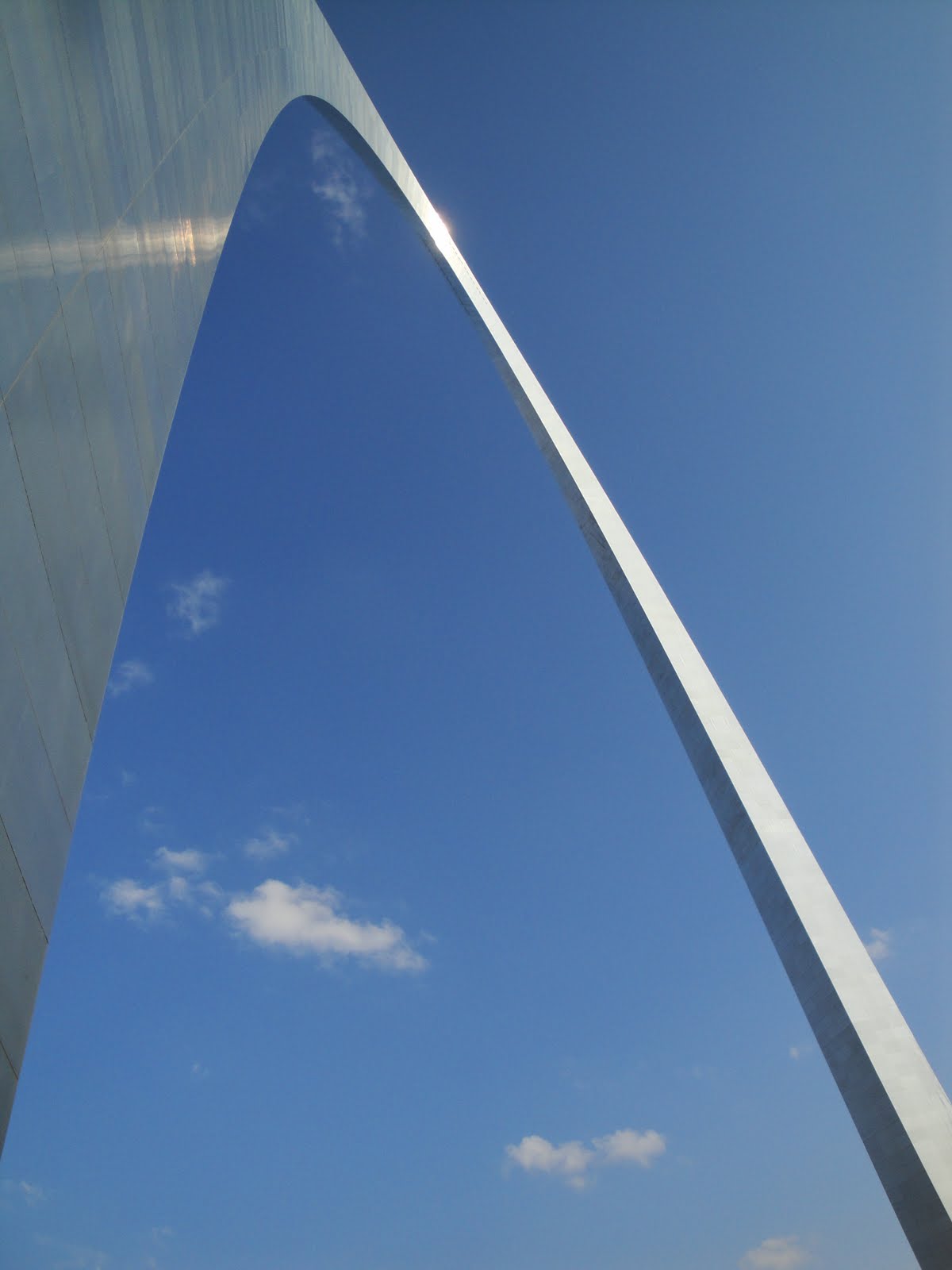
For several years, Cahokia has been one of those must-visit places for me, so I was thrilled that we could take time to see the site.  (I was even more thrilled that Paul was such a good sport about putting up with my nerdy infatuation with the place.)  We took a four or five mile hike around the site, visiting Mound 72 and Monk's Mound.  There was also a great late-80s/early-90s museum that made me feel like a kid again.  That evening, Paul and I drove into St. Louis to see the gateway arch and get some good beer at a local brewery.  From the little I got to see, I really liked the city.


Day three took us through Missouri (flat, but lots of trees), and Kansas (just as flat, but without all the trees).  I believe we were pretty tired of driving by this time, but there were some neat sights to be seen.  A lot of wind turbines, pro-life roadsigns (I think we saw the most in Missouri and Kansas), and corn.  Not much else to say about that.  We stopped for the night in Larned, KS, where we stayed with Paul's cousin Mark and his family.  They took us out for some delicious Mexican food and (my favorite) a trip to the county fair.  We got to see all kinds of animals, from chickens to goats to horses, as well as a neat rodeo.

 Roping a calf at the rodeo in Larned, KS

I'm convinced that the sky gets bigger as you go out west.  Maybe I'm just used to Virginia woods and buildings everywhere, but for real - there is so much sky to be seen.  You could see that more and more as we drove through the rest of Kansas and into Colorado.  There were some stretches of road in eastern Colorado where we didn't see anything (or anyone) but landscape for fifty miles or more.  It was absolutely beautiful once we started getting into the mountains.  Unfortunately, we hit a huge rainstorm between the Rockies and the San Juan mountains and it lasted all the way to Durango.

Nothing for miles and miles

It was a pretty cool (albeit exhausting) trip.  I must say I was very glad when the driving was over, though that meant dropping Paul off at the (tiny) Durango airport on Sunday morning.  I'll be picking him up ten weeks from that day - October 3 - for the return trip once my internship at Crow Canyon is finished.  We're going to take a little longer for the return journey, so I can give Paul a tour of some of my favorite places in the southwest.