Showing posts with label Southwest. Show all posts

Thursday, February 24, 2011

Where is Four Corners, really?


I visited the Four Corners monument on a family vacation in 2004, then again in October 2010.  It's not much to see - you pay three dollars per person to take your picture at a very ostentatious monument that's located on Navajo tribal land.  (Not until after the second visit did I discover the joys of frybread.)  This place is in the middle of nowhere.  Really, I mean it.

The middle of Nowhere (actually a nice place to visit)

Since the 2004 trip, I had heard rumors that the monument was actually misplaced when initial surveying was done in the 19th century. When Paul and I were driving through the area last October, my GPS placed the monument squarely in New Mexico.  As I was doing some of my geography reading a few weeks ago, Four Corners flashed into my mind.

Since Earth has a very irregular shape, geodicists (people who study the Earth's shape) create models called ellipsoids to make calculating geographic locations easier.  When a new ellipsoid called GRS 80 replaced the previously-used Clarke 1866 ellipsoid, the geographic coordinates for specific locations changed, usually between 10 and 100 meters.  But when I thought a little harder, I realized that this would in no way explain the supposed 2.5 mile discrepancy in the location of Four Corners.  So I did a google search, and found this article from the National Geodetic Survey (NGS), vehemently defending the accurate location of the monument.

I searched for the geographic coordinates, converted them to decimal degrees, and created the Mercator projection below showing the location of Four Corners.

Penn State Oneline GIS Education, 2011.

Next I checked google maps:


And there it is - right where it's supposed to be!  I suppose I really should believe the NGS after all.  And I suppose that means that even though Paul and I did not take any epic hail-showering voyages through Utah, he has, in fact, set foot in the state.  Or at least, on sovereign tribal land that just happens to fall in the state of Utah...

Oh Paul.  You would.

Wednesday, October 20, 2010

The Journey Home

Last Wednesday morning (and by this I mean back during our road trip), it was still raining.  As a Virginian, and more importantly, as a William and Mary alum, I am quite used to pouring rain that continues for days on end.  However, Wednesday was epic.  Weather like this doesn't happen every day in the southwest.

Hail-covered road near Flagstaff, Arizona
Our projected route took us out the south entrance of the Grand Canyon, southeast to Flagstaff, Arizona, then further east to Santa Fe, New Mexico.  As we checked the weather report for Flagstaff, there were predictions of thunderstorms, a chance of hail, and even a few brief tornado warnings.  Being that I am incredibly impatient, I insisted that we leave as planned.  It started hailing as we arrived in the small town of Williams, about twenty-five miles west of Flagstaff.  A cop was directing traffic off of Route 40.  Thirty minutes later, we made it onto the highway - only to find out that there had been several accidents.  The chilly temperatures (42 degrees F) allowed hail to accumulate on the road.  It looked like the area had been blanketed by a dusting of snow!  About ten miles from Flagstaff, we saw demolition caused by a tornado, right by the side of the highway.  Thankfully we got through the storm safe and sound (without seeing Phoenix's tennis ball-sized hail), and did not stop until the dark stormclouds were far behind us.
Central Plaza in Santa Fe
It was pretty smooth driving for the rest of the day - blue skies and white fluffy clouds all the way to Santa Fe.  Once we arrived, Paul and I strolled around town and looked around the cathedral.  Santa Fe is a beautiful Spanish colonial town - its layout reminded me so much of Antigua!  Lots of shops, churches, and a few museums that I'd love to return to visit someday.

On Thursday, we drove through Texas.  There was not much in Texas except farm towns and dust, at least along our route.  We made it to Mesquite, an eastern suburb of Texas, for the night.

At Cafe du Monde!
Friday we drove through the rest of Texas, then made our way through the beautiful bayous of Louisiana.  The landscape was quite refreshing.  By late afternoon we arrived in New Orleans.  I must say that in all my traveling, I had never experienced real culture shock until this moment.  The streets and cars and buildings and people were just a little too much for me to deal with after several months in the wide open spaces of Colorado.  All the same, I enjoyed our time in the Big Easy.  First we visited Cafe du Monde to try some fresh beignets and coffee.  Both were, of course, delicious.  We walked around the French Quarter a bit, then slipped into a brewpub for some craft beers, after which we found a little hole-in-the-wall place for gumbo and more local brews.  The walk back up Bourbon street was not nearly as awkward on the way back to our hotel as it had been on the way towards the French Quarter.  Thank you, beer.

New Orleans at dusk
Saturday took us through Louisiana, Mississippi, Alabama, and into Georgia, where Paul and I stayed with my Aunt Sharon.  It was nice to catch up - I hadn't visited her house since my family stayed with her during the 1996 Olympics in Atlanta.  And finally, on Sunday, after a very early morning Mass, we drove back up to Virginia (and a home cooked meal).  Finally.

It's funny how quickly I seem to have acclimated back to life in the east.   It's a whole different world - traffic lights and houses and highways and trees.  The sky isn't so big here - there's always something obstructing the clear blue (or gray and rainy) sky.

So what's next? you might ask.  I'm in the second week of an internship at the National Museum of the American Indian.  I work in the Repatriation department at the Cultural Resource Center in Suitland, Maryland - and I'll be there until right before Christmas.  I'll be sure to update soon (what is repatriation, anyway?)

Wednesday, October 6, 2010

Kegs and Kivas (and a big canyon)

Wild horses at Mesa Verde
Paul flew in Sunday morning, and thus began the great adventure of our return home.  After breakfast and Mass in Durango, we visited Steamworks brewpub, a local favorite.  I’d been meaning to visit this place since my first week in Colorado – there was an hour and a half wait during our first intern night out.  The beer was delicious.  Paul tried their gold-medal-winning stout (he let me have a few sips) and it was excellent.  After our beer adventure, we drove to Mesa Verde National Park and spent a couple hours touring Spruce Tree House, making friendly conversation with park rangers, and getting stuck behind people in SUVs who stopped in the road to take pictures of wild horses.  We had to stop, so Paul snapped a picture of the first pair of horses we saw.  We ended our evening in Dolores – an old railroad town just northeast of Cortez.  Our hotel was right across the street from the “pub” (Dolores River Brewery), so we walked over for a couple beers and a pizza.

Spruce Tree House!
We had a slow morning on Monday – Dolores is the kind of town where people gather at a restaurant every morning to shoot the breeze over breakfast.  As such, we didn’t make it out to the site (Goodman Point Pueblo) until after nine.  I gave Paul the quick tour of my “workplace,” then we took a short walk around Crow Canyon’s campus.  By noon we reached the tourist trap that is the Four Corners monument (hey, you kind of have to do it) and took appropriately silly photos before hitting the road again.  The afternoon drive through stormy monument valley/Navajo and Hopi reservations was beautiful.  When we were about half an hour from the Grand Canyon entrance, we ran into a pretty strong storm.  It was pouring by the time we could see the canyon, so of course I had to run around and take a look.  After a few more miles of driving, the rain had stopped and the canyon was full of white, cloudy mist.  Just a few more minutes later, the mist was completely gone.  I’ve seen a very different side of the canyon than in July of 2004 when I was here with my family.

Misty Grand Canyon
Today we had planned to spend the day hiking – but awoke to the sound of rain on the roof.  Thankfully it let up and after a hearty breakfast, we started hiking into the Canyon.  It rained on-and-off, which made for some wet, muddy hiking.  We made it to the first stopping point a mile and a half down, and figured we should head back before the weather got worse (which it did).  By the time we got back to the top, visibility was very poor – at times all you could see was the trail!  We kept ourselves occupied this afternoon, visiting some 13th century ruins and a small museum near the east entrance to the park.  It was interesting to see the differences in kiva structure and size – smaller and with some different architectural features than Mesa Verde or Chacoan kivas.  On the way back we got a glimpse of a rainbow in the misty canyon – then saw the mist blow away over the course of about five minutes.  Crazy!

As I write this, the rain falls yet again on the roof of our lodge.  I’m pretty sure the rain is supposed to stop tomorrow afternoon – and we’ll be well on our way to the next stop on our journey – Santa Fe!

Saturday, October 2, 2010

Saying Goodbye

It is the nine o'clock hour; I'm sitting in my basement "office," gathering my things and crossing a few last to-dos off the list.  Campus is quiet, but for the sprinklers and the other interns, in a slightly modified version of our Saturday night routines.  My car is packed, my phone is charged, and I made my last several-minute commute to the "super hogan" bathroom for a shower.  Those of you who are well acquainted with my usual before-I-leave routine know that I am usually up all hours of the night packing.  I can't tell you how strange this calm, peaceful night feels.  Paul's plane lands in Durango in about twelve hours.  I may not sleep tonight after all.

Around noon today, I drove up to Dolores.  I rolled the windows down, opened the sunroof, and let the wind blow through my hair as I drove down the country road, accompanied by mesas and mountains in the distance.  I will miss this, I thought.  I will miss the sunrise and the purple mountains in the morning; the late evening sun shining on Mesa Verde to the east, clouds every color of the rainbow.  I will even miss hot afternoons in the field, baking under the dry sun, looking to the southwest in hopes of a few clouds for shade.  This country is a wonderful, peaceful place.  But it's time to leave.  Virginia is home.

We took a midweek field trip to "Big Point"
I finished up work in the field on Friday - I did paperwork on several units, backfilled, and drew a profile map of a kiva.  Now Steve and Grant (my supervisors) will be racing against time to get all the units finished up before the snows come in a month or so.  We had a party last night - it was a good way to say goodbye to the staff, and enjoy a few more local brews.  Crow Canyon, and Cortez for that matter, is an awesome community.  People are so friendly out here - I will miss the random conversations with townies and cashiers in little shops.  Perhaps I just need to look a little harder to find these things at home.

Kiva unit - look at that huge hearth!
Paul and I will be making our way home over the course of eight days and about three thousand miles, including visits to Mesa Verde, Four Corners, the Grand Canyon, Santa Fe, Dallas, New Orleans, and Atlanta - and as many brew pubs as we can find!

Tuesday, September 28, 2010

Golden Aspens and Golden Brews

Last Wednesday, amidst storm clouds and rain showers, Mom and Dad flew out to Colorado for a visit.  We packed a lot into four days - a winery, three breweries, seven mountain towns, explorations of the Great Sage Plain (where I live) - and Mom and Dad even made it out to see the red rocks of southwestern Utah.
 
San Juan Mountains outside of Telluride
The mountains:  It's a beautiful time of year up north in the mountains of Colorado.  The aspen trees turn to gold and shed their leaves onto fir trees, creating an almost Christmaslike spectacle.  We drove along the San Juan Skyway - north first through Dolores, then passed Rico on the way to Telluride, where we spent the night.  Telluride is a pretty snazzy, yuppie ski town - plenty of neat restaurants and expensive-like-woah real estate.  It was a fun place to stay.  We took the gondola more than two thousand feet up the mountain (we were very proud of Mom, but that didn't keep us from teasing her mercilessly) and ate a delicious dinner at a little Italian bistro on the main drag.  On Saturday we drove northeast through Ridgway, Ouray, Silverton, and Durango on our way back to Cortez.  The drive between Ouray and Silverton (known as the "Million Dollar Highway") was a breathtaking drive.  The road is cut into the mountain, so you're right there in the wilderness.

Million Dollar Highway
The brews: When I arrived in Colorado several months ago, I found out that the region is well known for its brewpubs.  Pretty much every town of at least moderate size (even with populations less than a thousand) has a thriving pub that brews its own beer - I believe the philosophy is "drink locally," not just "eat locally."  Most of the places have great atmosphere, and a lot of awesome beer to taste.  Mom, Dad, and I visited Cortez's Main Street Brewery, the Dolores River Brewery, and the Silverton Brewery, and also Guy Drew Vineyards during our long weekend.  Silverton hands down had the best beer (I had the delicious Red Mountain Ale), and Guy Drew's wine was excellent - I especially liked all the dry whites.

Mom and Dad on the gondola in Telluride
It's hard to believe that Mom and Dad's visit went so quickly - and that my days out west are quickly drawing to an end.  I only have three more days in the field - finishing up documentation on two 1x1 meter units, and getting to work on a nearby kiva.  I can't say I'll miss the hot sun, but it has certainly been awesome to get hands-on experience doing southwest archaeology.  The wilderness has been giving me some lovely goodbye presents lately - yesterday we heard coyotes calling nearby, and today we saw a big bull snake in the path!  I'm going to miss spending so much of my time out-of-doors.

Tuesday, September 21, 2010

Chance Encounters

It's been a pretty quiet week - no big thunderstorms, field trips, or life-changing events.  I spent almost the entirety of last work week digging a small test unit (1x1 meter) - it just kept getting deeper and deeper, and I couldn't find any indication of sterile (sans artifacts) soil.  Alas, today my supervisor and I pulled out the big guns - a rock pick - and after some probing, he decided that it's probably an early kiva (circular subterranean structure).  So it looks like I have a lot of digging to go, but at least now I have some perspective.

I sit under this tree during lunch, and also occasionally nap.
This past Saturday was Crow Canyons second annual Open House Festival - visitors came from near and far to explore our reconstructed pithouse and pueblo, learn to throw an atlatl, and enjoy Chef Jim's delicious green chile stew!  It was a beautiful day and a lot of fun to see so many families enjoying campus.  It's days like these when I realize that while I enjoy archaeology, my passion is also to teach and make research accessible on lots of different levels.  As many of you also know, I am quite fond of talking, and it was fun to get to chat with so many different people during the Open House as well.

Friendship dance with the Pow Wow dancers at the Open House

On Sunday I made an expedition to a local coffee shop, in search of some good coffee and a change of scene.  The coffee was indeed delicious (I had the Guatemalan blend, of course), and I had some time to catch up on letters.  I also spent several hours in friendly conversation with a local storyteller (Remember Lorenzo?  This man was like his PG counterpart).  Cortez is such a welcoming place.  The community, if not the landscape, is probably my favorite thing about the area.

Mom and Dad are due to arrive in less than 48 hours - I can't express my excitement!  It will be so much fun to show them around Cortez and Crow Canyon, and I'm especially looking forward to our expedition into the mountains: Durango, Silverton, Ouray, Telluride, Rico, and Dolores.  The best part?  Each town has its own brewery!

Monday, September 13, 2010

On Home, and Hovenweep


All of the sudden, my life here has become almost, well, busy.  I'm down to the last three weeks of my internship, and perhaps for the best, I'll be working a lot, and running all kinds of crazy places before Paul flys out for the "extended" trip home.  I've snagged a sweet babysitting job, Crow Canyon's open house is set to happen this Saturday (somehow I've been assigned to the decorating committee...), and to boot, Mom and Dad are flying out for a visit mid-next week - we'll be driving up north into the mountains for a couple days.  I can't say that I'll miss the gloriously lazy evenings and weekends on campus too much.  I was never very good at being bored - or being motivated to get anything done unless there's a deadline.  As much as I despise beltway traffic and sprawling suburbs, it will be so good to be home.

Home.  It has come to mean so many different things to me over the past few years.  Home, where I grew up.  Home, where I walked colonial streets and figured out what kind of person I wanted to be.  Home, where I walked Spanish colonial streets and figured out what kind of person I wanted to be.  Where there are always people bugging me to bake pie; where leaves fall in the autumn;  where scorpions and rattlesnakes do not roam.  But most of all it's a place where I share my life with loved ones, and where I can be at peace with God.  It's human intimacy - in the best, most wholesome sense of the word - that I miss most when I'm away.  Hugs.  Heartwarming conversations.  Coffee.  Meals.  Smiles.

I remind myself each day that I am living such a wonderful experience out here.  I breathe deep as I walk up to my cabin in the chilly evening air, gazing at the big dipper and the milky way.  I soak in the sun during lazy lunches in the field.  I savor the delicious southwest-style food that the kitchen staff cooks up.  Life won't always be this simple, and this time is truly a gift.

My supervisor pulled one of these out of a kiva on Friday!

Last Saturday we took another intern field trip.  First we visited the Anasazi Heritage Center just a few miles north in Dolores, CO.  It was really cool to see some artifacts on display (mostly some unusual ceramic vessels), and grind maize with a mano and metate (it's really hard work!)  In the afternoon we drove west, across the border to southeast Utah.  A note on Utah: it's really desolate, at least the eastern portion that I have seen, aut at the same time the landscape is absolutely magnificent.  We visited the main site (Square Tower) of Hovenweep National Monument and hiked a few miles into and around the canyon.

Hovenweep's "Twin Towers," a fitting reminder for 9/11

It was a late site, late 13th century, with a whole ton of towers on the rims of canyons.  The function of towers in this period is still in many ways a mystery.  The fact that they built a big one inside the canyon leads me to believe that their function was not just defensive.  In any case, we headed back to Cortez in the early evening for a delicious dinner at the home of one of Crow Canyon's archaeologists, where I ate green chile stew, my new favorite food, for the first time.  I'm serious, this stuff is delicious.  It's like southwestern-style pot pie.  Only better.

The "Castle"
Excited for home, three weeks and counting.  But trying to make the most of every day I have left on the great sage plain.

Friday, September 10, 2010

Field Archaeology 101

It occurred to me a couple weeks ago that the practice of archaeology is a pretty abstract idea in most people's minds.  What do you think of when you imagine an archaeologist working in the field all day?  It's probably a lot different from what you would expect.  Yes, we dig holes, and yes, we collect artifacts - but we also take photographs, keep very exact measurements, make maps of our units, and spend a lot of time recording anything and everything about the soil.

The tools: tarp, buckets, dustpan, trowel and brush

One of the most important things to keep in mind about archaeology is that we record everything.  We want to know exactly where we are digging horizontally (this is where satellite technologies like GIS and GPS come in handy), and vertically, which means taking constant measurements of elevation.  Before you start to dig a unit, you have to plot its location on a map, and lay out its measurements with nails and string.  When you're trying to get a feel for how people used the landscape in the past, you have to be exact.  Most of what you'll learn from an artifact comes from its location (in archaeology jargon, its provenience).  That means digging a unit within the boundary of the strings, and also in vertical levels based on how the soil was deposited.

This unit has already been dug, but I need to document it

Units are usually measured in meters, except occasionally at historic sites.  The photo above is a 1x1 meter unit - this one was part of a midden, or an area where people deposited their refuse.  We find all kinds of things - pottery sherds, flakes from the construction of stone tools, charcoal, bone, and a whole lot of sandstone that was used for construction.

First thing's first - clean off all the crap!

Since the student and adult participants at Crow Canyon do most of the digging, my job is to take care of residual documentation, and get units ready to backfill (throw the dirt right back in).  I first clean the unit, and make sure we have reached sterile soil - that's what was there before people used the land.  It usually has a high concentration of clay, so it's the yellowish-red color you can see above.  This unit looks done - the brown stain in the lower half of the unit was probably caused by rodent activity.

The surface of a pit feature

Sometimes, however, once you get through a layer of soil, you can see the imprint of a feature, something caused by cultural activity that can't be removed from the ground and studied like an artifact.  The above photo represents a pit that was cut into the yellowish-red clay by people who lived here 800-900 years ago.  My job is to excavate the feature, taking lots of notes (and photos!) along the way.

I bisected the pit feature to look at a profile of the fill
All done!  A final photo for this midden unit.

Once everything in a unit is excavated, I take final photographs of the unit.  It is important to provide shade for photos with a tarp, so that the difference in color won't distort the picture (my earlier photos would not be appropriate for a site report - the ones above are much better).  There should always be an arrow or a trowel indicating north in the photo, to best record the orientation.

The tools: clipboard, graph paper, pencil, ruler, line level, tape measure

Finally, I finish up the unit by drawing a profile map to keep track of the change in soil color and texture.  We use a book called the Munsell soil color chart - just imagine a bunch of paint samples in dirt colors, bound together in a book - to try to be as objective as possible about the soil color.  It's more tedious work, but important for understanding how the soil layers were deposited, and thus learning about the relationship of one unit and its artifacts to another.

After that is another story - stay tuned to learn about artifact processing back in the lab!

Monday, September 6, 2010

A Tale of Two (or twenty) Kivas

Last weekend - back when it was still August - the interns took a weekend camping trip to New Mexico.  We're only about an hour from the border, and it took us about two hours to arrive at our first destination: Salmon ruins.  Salmon (pronounced Sal-mun after a local family, not the fish) is a site known as an "outlier" to the political/social/economic system of Chaco Canyon.  Think of the Roman Empire, and the way that Roman architecture spread throughout Europe in the early centuries AD.  Chaco was kind of like that - and associated sites are identifiable by similar architectural traits, burial patterns, kiva styles, and a lot of attention paid to astrological alignment, among other factors.  Salmon archaeologist Paul Reed gave us a behind-the-scenes tour of the site - meaning we got to learn about cool things like potential cremation remains and coprolites (yep, centuries-old poop) - and the destruction and reconstruction of Salmon's great kiva after a huge flood in the twelfth century.

Great House (Pueblo Bonito)
After our tour of Salmon, we drove another hour or two south to Chaco Culture National Historic Park.  Chaco has been on my list of places-to-visit since I first learned about it my freshman year of college.  As I have mentioned before, Chaco Canyon was (debatably) a huge political/social/economic system operating in the southwest between the ninth and twelfth centuries AD.  Chaco is known for its monumental architecture: three or four story "great houses" - village-size communities, and "great kivas," really big variations of the circular underground religious structures still used in modern Pueblo societies.  T-shaped doors, architecture with small, narrow stones and bands of dark stones, and "chinking stones" are also traits associated with Chaco.  (Are you still awake?)

Great Kiva (Chetro Ketl)

T-shaped door (Pueblo del Arroyo)

Banded masonry (Pueblo Alto complex)

We spent the weekend hiking and touring Chaco Canyon's bounty of great houses.  We also saw a lot of petroglyphs (pictures carved into rock), and some pictographs (pictures painted on rock) and did a lot of stargazing - there were some pretty cool shooting stars.  There is very little light pollution in Chaco, and we went to a presentation on astronomy given by a park ranger on Friday night, and even got to look through a gigantic telescope.

Petroglyph
Supernova pictograph

It was my first experience camping since the fateful night freshman year when I sprained my ankle.  Definitely a fun (injury-free!) weekend.  I'm pretty sure I ate my month's allowance of peanut butter in three days.  Peanut butter on both sides of the bread keeps the bread un-soggy from the jelly.  A peanut butter apple with granola is also a lovely breakfast.  Peanut butter is pretty much indestructible, and delicious.

Saturday, August 21, 2010

Destination: Mesa Verde National Park

Durango & Silverton Railroad (2004)
Right now I'm sitting outside a hole-in-the-wall bagel shop in Durango - about 50 miles east of Cortez.  This morning I drove one of the interns to the airport at oh dark thirty, so I figured I'd enjoy the change of scene out this way.  Durango is definitely a tourist town - complete with artsy shops, a historic railroad, and a lot of unique places to eat.  It's definitely a treat to get a bagel - you don't see them very often between St. Louis and well, California.

Mesa Verde at dusk
Today completes week four of my internship.  I just about have the weekly routine down (including unofficial field trip Fridays) and time is starting to pass a little more quickly.  This past week the interns got a taste of Crow Canyon's weekly program for students and adults who come to learn about archaeology.  We got to tag along with the adults in the lab, and the lab interns (also known as "labbies," we are "fieldies") got to come dig with us.  The week also included a field trip to Mesa Verde National Park (making it my second consecutive Friday in the park) about an hour southeast from Cortez.

Balcony House
Last Friday, I took a trip to Mesa Verde while most of the other interns were networking at the Pecos Archaeological Conference (I figured I'd save my networking for the east coast).  I drove around the park, getting a chance to see all kinds of pithouses and cliff dwellings.  I also took a tour of Balcony House - which meant climbing a 30-foot ladder to get to the site, and crawling through a narrow tunnel to get out.  It was a neat site - though I don't think Mom would have liked the heights very much :-P  In the evening I stuck around the park to hear George Mason Professor James Snead give a lecture on his research concerning ancient roads.

Mug House
Yesterday we toured Mug House - a pretty out-of-the-way cliff dwelling on Wetherill Mesa (to the west of Chapin Mesa, the main attraction).  We really had to do some adept rock-crawling to get down to the site, but it was worth it.  We got to see a painted kiva, and some pretty cool other structures.  The interns also drove to Spruce Tree House on Chapin Mesa.  It is splendidly preserved, and it was pretty awesome to give it a look with a more discerning eye than I had at 16 (when I visited Mesa Verde with Mom and Dad).

Otherwise, I've been doing a lot of chilling out, tasting the local beer (the writers of Dear Beer Friend would be proud), and working my way through the first season of Glee and The Columbian Exchange.  I wanted to thank everyone SO MUCH for sending me mail.  It is really nice to come back from the field and find a letter or postcard in my box.  You guys are awesome.

Interns at Mug House

This weekend: relaxation.  Next weekend: the great Salmon ruins and Chaco Canyon expedition.  It's going to be pretty epic - so keep your eyes peeled for an excited post mid-week six!

Sunday, August 8, 2010

Island in the Sky

I arrived at Crow Canyon two weeks ago today and I'm finally pretty well settled in.  I live in a "rustic" cabin, maybe about eight by ten feet.  One of the interns calls it her shed.  My grandma said it looked like an outhouse.  I'll let you decide.  It works out pretty well - I don't have heat, AC, running water, or electricity - but I can get all of the above in the nearby lab building (where I am now).

Home sweet home


I spend my days in the field, and by that I mean inside a one meter deep hole.  Crow Canyon's participants (middle schoolers, high schoolers, and adults) do most of the digging at the site, but that leaves all the finishing touches and documentation to the archaeologists, Grant and Steve, and to us interns.  This is the last year of the project, so there's a lot of work for us to finish up in the field.  This week I should finish digging my unit, which is part of a midden (think: trash heap) that's probably a thousand years old - I have to look at the pottery I've found to get a better idea.  Ancient trash.  Cool.

Hanging out at Woods Canyon Pueblo
Since there are a bunch of new interns on campus, we've been taking a lot of trips to nearby sites.  Susan Ryan, one of the research archaeologists, took us to Albert Porter Pueblo and Woods Canyon Pueblo to the north.  Porter and Woods were among a group that Crow excavated earlier in the 2000s.  You have to have a sharp eye and be able to read the landscape and surface scatter of artifacts to figure out where sites are.  It was a little more obvious at Woods Canyon - as you can see below.

The interns at Aztec
We also had the chance to visit Lowry Pueblo, which is at Canyon of the Ancients National Monument.  Like many of the sites out here, Lowry was excavated and preserved early in the 20th century.  It has a very large kiva (or as my adviser would say, a "big ass kiva") - a kiva being a subterannean structure used as a gathering place for religious and community purposes that exhibits some signs of influence from Chaco Canyon (you'll be sick of hearing about Chaco by the time I leave in October).  This Friday we took an intern field trip to Aztec, a site in New Mexico that was most likely a colony or "outlier" of Chaco Canyon.  It was a neat site, and we had fun hanging out with the Park Service archaeologists and becoming junior rangers.

Courthouse Rocks at Arches Nat'l Park

Yesterday a couple of us also took a day trip to Utah to check out Arches and Canyonlands National Parks.  I must say, it was pretty darn cool.  We took a few fun hikes in Canyonlands (Islands in the Sky district - so aptly named!), and the views were just breathtaking.  It was drizzly for most of the afternoon, and rained for the drive back to Colorado, but the clouds made nature look all the more mystical.

Mesa Arch at Canyonlands

Tuesday, August 3, 2010

Monuments, Mounds and Mountains

Two weeks back (yeah, I'm really behind the times) Paul and I embarked on our grand trip our west - four days, 2000 miles from Clifton, Virginia to Durango, Colorado.  It was actually a really neat trip - traveling through different cultural and physical landscapes, seeing the west unfold over a couple days, and trying to get the best gas mileage possible in my Jetta (and analyzing the reasons why we weren't getting as good mileage as we could).  Day one took us to Indiana, Day two to western Illinois, the Cahokia Mounds site, and St Louis, day three to Kansas, and day four to Colorado.


Did you know that it takes a very long time to drive through West Virginia and Kentucky?  We spent most of the day doing just that - going first through western Maryland, then lengthways through both WV and KY.  A lot of rolling hills and farms and that still-near-home feeling.  We stopped for the night in Evansville, Indiana, just shortly after everything got flat.

Monk's Mound from a distance - it's so big that it's hard to get a good picture!


After all that driving, we were glad to have only a few hours to our destination for day two: Cahokia Mounds Historic Site.  Anyone who is a student of North American archaeology knows that Cahokia is just about as cool as it gets.  It is the best example of a pre-Columbian city north of the Rio Grande; at Cahokia's height 15-20,000 inhabitants lived on the site.  Just across the Mississippi River from St. Louis, Cahokia was a huge center of the Mississippian "mound-building" tradition.  Today the park preserves about 70 of the 80-100+ mounds that Native Americans built early in the second millennium AD.  Some have burials, but others were most likely used for ceremonial purposes.  Most prominent is Monk's Mound, the largest pre-Columbian earthwork in North America.

Paul and me halfway up Monk's Mound

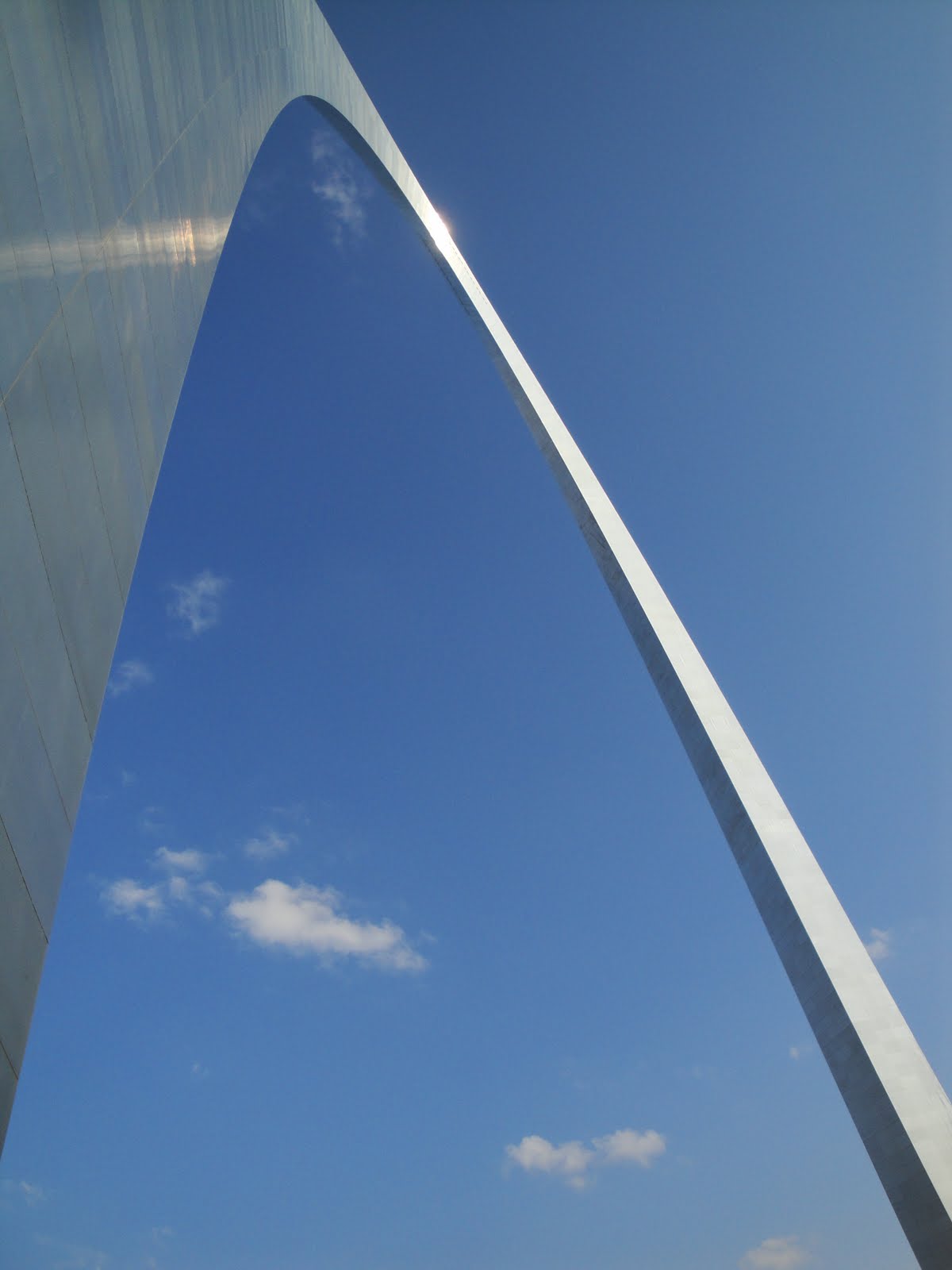
For several years, Cahokia has been one of those must-visit places for me, so I was thrilled that we could take time to see the site.  (I was even more thrilled that Paul was such a good sport about putting up with my nerdy infatuation with the place.)  We took a four or five mile hike around the site, visiting Mound 72 and Monk's Mound.  There was also a great late-80s/early-90s museum that made me feel like a kid again.  That evening, Paul and I drove into St. Louis to see the gateway arch and get some good beer at a local brewery.  From the little I got to see, I really liked the city.


Day three took us through Missouri (flat, but lots of trees), and Kansas (just as flat, but without all the trees).  I believe we were pretty tired of driving by this time, but there were some neat sights to be seen.  A lot of wind turbines, pro-life roadsigns (I think we saw the most in Missouri and Kansas), and corn.  Not much else to say about that.  We stopped for the night in Larned, KS, where we stayed with Paul's cousin Mark and his family.  They took us out for some delicious Mexican food and (my favorite) a trip to the county fair.  We got to see all kinds of animals, from chickens to goats to horses, as well as a neat rodeo.

 Roping a calf at the rodeo in Larned, KS

I'm convinced that the sky gets bigger as you go out west.  Maybe I'm just used to Virginia woods and buildings everywhere, but for real - there is so much sky to be seen.  You could see that more and more as we drove through the rest of Kansas and into Colorado.  There were some stretches of road in eastern Colorado where we didn't see anything (or anyone) but landscape for fifty miles or more.  It was absolutely beautiful once we started getting into the mountains.  Unfortunately, we hit a huge rainstorm between the Rockies and the San Juan mountains and it lasted all the way to Durango.

Nothing for miles and miles

It was a pretty cool (albeit exhausting) trip.  I must say I was very glad when the driving was over, though that meant dropping Paul off at the (tiny) Durango airport on Sunday morning.  I'll be picking him up ten weeks from that day - October 3 - for the return trip once my internship at Crow Canyon is finished.  We're going to take a little longer for the return journey, so I can give Paul a tour of some of my favorite places in the southwest.